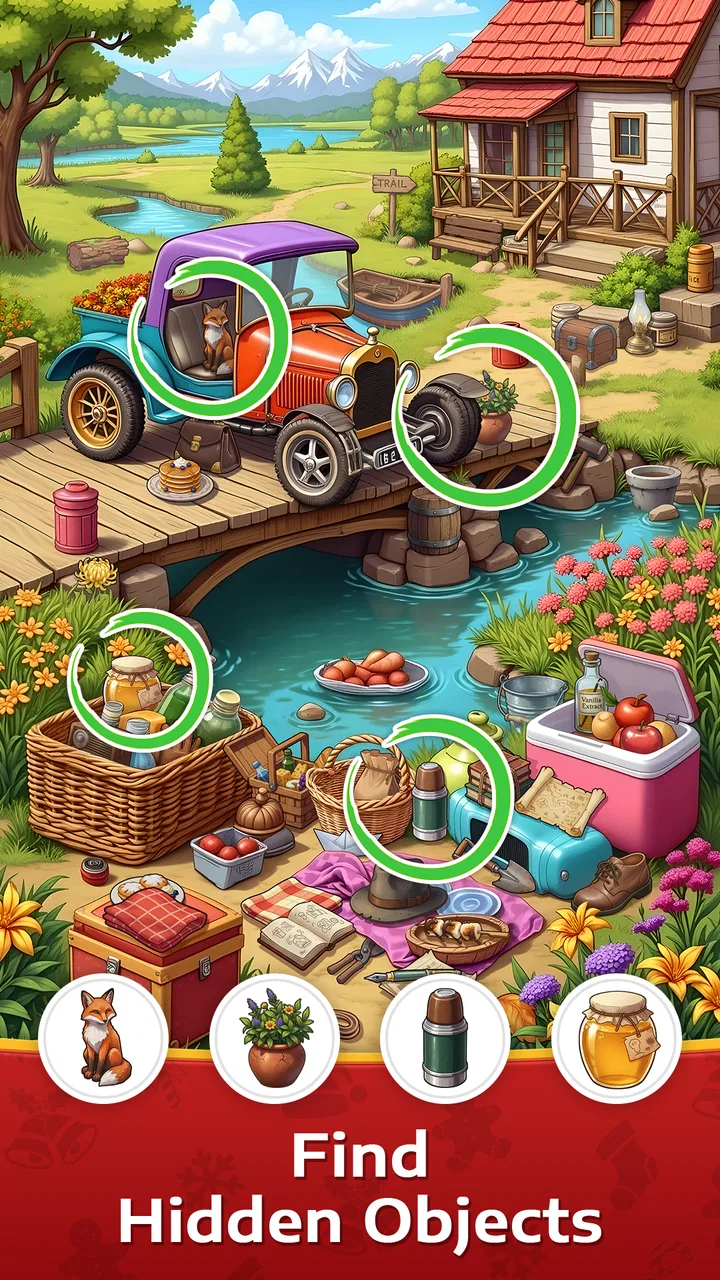
Find It® - Hidden Object Games
- 4.9
- Rating
- 5.00M
- Installs
- Free
- Price

 Analysis by App-foxy
I approached Find It® - Hidden Object Games expecting a lightweight way to pass a few quiet minutes, and that is exactly where it makes the strongest impression. This is a puzzle game from Guru Puzzle Game built around searching illustrated scenes for objects that are easy to overlook. The idea is familiar, but the appeal comes from how it turns ordinary observation into a calm, focused activity rather than a frantic contest.
After spending time with it, I see it as a good fit for people who enjoy visual puzzles, gentle brain training, and games that can be played in short sessions. It is free to start, rated for Everyone, and has attracted a large audience, with an average rating of 4.9 from around 216 thousand ratings. Those numbers do not guarantee that every player will love it, but they do match my impression that the basic loop is immediately understandable and broadly accessible.
How the current game feels to play
The central task is simple: examine a busy picture and locate the requested hidden items. That simplicity is important because there is almost no learning curve. I can open the game, understand what I need to do, and begin searching without first studying a complicated rule set. The challenge comes from the artwork, overlapping details, similar colors, and the tendency of the eye to skip over objects that are actually in plain sight.
You May Also Like

 Blood Strike: 2.5 Anniversary
Blood Strike’s Loadouts Turn Every Drop Into a Tactical Gamble
A close look at Blood Strike’s custom loadouts: how fast access to signature weapons reshapes its battle royale rhythm, rewards preparation, and narrows the gap between fights.

 Pandora - Music & Podcasts
Pandora’s Music Is Easy to Start, but Harder to Recover
Pandora’s strength is its low-effort path from a seed to a station. Its weak spot is how much confidence it asks you to place in connection, setup, and quiet recovery.

 8 Ball Pool
 Is Built on Rivalries, Rematches, and Routine
A close look at the rivalries, rematches, shared routines, and unanswered safety questions that turn a quick pool match into a persistent mobile community.

 Samsung Music
’s Quiet Strength Is Playing What You Already Own
Its reach comes less from spectacle than from dependable access to a personal library. That simplicity is both the app’s strongest retention engine and its ceiling.

 AccuWeather: Weather Radar
AccuWeather Review: A Quick, Clear Forecast for Everyday Decisions
For everyday plans, the best forecast is the one you can understand quickly. AccuWeather makes rain timing, radar, and local conditions easy to act on, with a few trade-offs.

 Hill Climb Racing
Why Hill Climb Racing Still Turns Crashes Into One More Run
A tiny car, a bumpy hill and one more upgrade: Hill Climb Racing keeps resurfacing because its simple chaos makes every near-miss feel personal.
More From Our News Desk



What I like most is the change in pace compared with many modern puzzle games. There is no need to build a complicated strategy before starting a level. I simply scan the scene, form a mental list of likely areas, and tap when something matches. That makes it suitable for a short break, a quiet evening, or a shared activity with a child who enjoys pointing things out.
The search process rewards patience more than speed. I usually begin with a broad sweep from one side of the image to the other, then return to crowded corners and areas where several shapes blend together. This is more effective than tapping randomly. A useful habit is to divide each picture into small zones and finish one zone before moving on. It reduces the chance of repeatedly checking the same obvious area while ignoring the edges.
That method also reveals one of the game’s better qualities: it encourages visual discipline. I am not merely looking for an object in the abstract; I am comparing silhouettes, colors, textures, and context. A small item may be disguised by nearby decoration, while a familiar shape may appear in an unexpected place. For players who want a relaxing activity that still asks them to concentrate, this balance works well.
The game is especially approachable for families because its age rating is Everyone and the premise is easy to explain. I could imagine handing the device to someone who does not normally play games and having them understand the objective within moments. It is also a reasonable choice for older players who prefer clear goals and visual interaction over fast controls or complex menus.
A practical routine for difficult scenes
When a scene becomes stubborn, I avoid zooming around without a plan. I first identify the items that have distinctive outlines, then use those as anchors. After that, I search for objects with unusual colors or shapes before tackling the items that visually resemble the background. If I am still stuck, I pause for a few seconds and look away from the screen. Returning with fresh eyes often works better than continuing to stare at the same section.
Another useful trick is to read the requested object as a visual category rather than a single perfect image. If the target is something that can appear in several forms, I look for its defining features instead of expecting an exact size or orientation. This prevents me from dismissing a partially hidden item simply because it does not look like the first example I imagined.
These habits are not advertised as a separate strategy system, but they make a real difference. The game becomes more satisfying when I treat each picture like a small investigation instead of a tapping exercise. That is also why I think it can work as a gentle attention exercise, although I would not treat it as a replacement for a structured educational or clinical tool.
What the recent version tells me
The current version is 2.31.0, which suggests that the game is being maintained rather than left as a one-time release. It first appeared on March 7, 2024, and the continued version progress is relevant for anyone deciding whether to invest time in it. A maintained puzzle game is more reassuring than one that feels abandoned after launch, especially when the main attraction depends on having enough scenes to keep the routine fresh.
At the same time, version information should not be confused with a promise of a particular feature. I can confirm the current version and the game’s ongoing presence, but I would judge it by the quality and variety of the scenes available in the version installed on my device. The important practical point is to keep the app updated through the normal store process if I want the current build, since puzzle games benefit from continued maintenance even when their core controls remain unchanged.
The developer, Guru Puzzle Game, has positioned this title within a familiar hidden-object format rather than trying to turn it into a broad role-playing or competitive experience. That focus is a strength. I always know what kind of session I am getting, and the game does not ask me to learn unrelated systems before I can enjoy the search.
Its popularity is also substantial: the game has passed five million installs and has more than five thousand written reviews. I read that as evidence of reach, not as proof that every scene or design choice will suit every person. Hidden-object games are highly dependent on visual taste. Some players will enjoy carefully scanning a detailed illustration, while others will find the same density tiring.
How it fits into everyday use
A realistic use case is a ten-minute wait at a clinic, station, or café. Instead of opening a game that demands a long uninterrupted round, I can complete a small search task and stop without losing the point of the session. The same applies before bed, provided I keep the screen brightness comfortable and do not let “one more scene” turn into a much longer session.
I also see potential for low-pressure shared play. One person can hold the phone while another suggests where to look, making the scene a cooperative observation exercise even though the game itself is designed around individual tapping. This works particularly well with children because adults can focus on asking questions—“What color are we looking for?” or “Which corner have we not checked?”—rather than simply giving away every answer.
For a commuter, the game can be more practical than a reflex-based puzzle because the mental demand is steady rather than dependent on rapid input. However, I would still avoid playing while walking, crossing roads, or doing anything that requires full attention. The calm format is not a reason to ignore ordinary safety.
Where it beats familiar alternatives
Compared with match-three games, this title gives me less pressure to optimize chains, boosters, or board layouts. I am not waiting for a lucky arrangement of pieces. My progress depends mainly on observation. That makes it a better choice when I want to slow down and look carefully rather than chase a high score.
Compared with crossword or word puzzles, it asks for less language knowledge. Someone can enjoy the visual search without being comfortable with spelling, clues, or vocabulary-heavy challenges. That makes the format more welcoming across ages and language backgrounds, although the exact object labels still need to be understandable to the player.
Compared with fast arcade games, it is much less demanding on reaction time. I prefer it when I want concentration without stress. The trade-off is that it may feel too passive for players who need constant movement, escalating difficulty, or a strong competitive target. Someone who enjoys action, timed battles, or deep tactical planning should probably choose a different category.
It also differs from traditional spot-the-difference games. Here, my attention is directed toward finding specific objects rather than comparing two nearly identical images. If I enjoy cataloging details and scanning a full scene, that distinction is welcome. If I prefer a very precise visual comparison with a clear before-and-after structure, another puzzle format may feel more rewarding.
Small strengths that matter in practice
One strength is the low barrier to entry. Because the objective is visible through the scene itself, I do not need to remember a long chain of instructions. Another is the natural stopping point created by individual searches. I can finish a task and put the phone down, which is more convenient than games that make me feel I am abandoning a long match halfway through.
A less obvious benefit is that the game gives me a reason to change how I look at an image. Instead of staring at the center, I deliberately inspect borders, empty-looking spaces, and areas where textures repeat. That scanning habit is transferable to everyday visual tasks, such as checking a crowded shelf for a particular item or finding a detail in a map. It is not a formal skill course, but the interaction encourages a useful kind of structured attention.
Another positive is its suitability for mixed-skill groups. A very experienced gamer and someone who rarely plays can start from the same basic understanding. The experienced player may search more efficiently, while the newcomer can still contribute by noticing a hidden shape. That makes it more socially flexible than games built around memorized controls or specialized strategies.
Where the experience may lose its appeal
The same focused simplicity can become repetitive. If I want a dramatic sense of progression, a large story, character development, or a changing set of mechanics, I will not find that in the basic hidden-object premise. The pleasure depends heavily on whether I enjoy examining scenes for their own sake.
Visual density can also be a weakness. A well-hidden object creates a satisfying moment of discovery, but a target that blends too closely into the background may feel less like a fair puzzle and more like a test of persistence. I find it important to distinguish between a difficult search and an exhausting one. When every item is hard to see, the relaxing quality starts to fade.
There is also the usual consideration with a free mobile game: optional purchases are present, with individual in-app items priced at $9.99. I would not spend automatically just because a scene is taking time. My preferred approach is to use the search techniques first, take a break, and decide whether the extra convenience is genuinely worth it. Players who want a completely purchase-free experience should keep that point in mind before settling into the game.
The absence of competitive pressure will be either an advantage or a limitation depending on the player. I appreciate not having to compare my performance with strangers, but someone motivated by leaderboards, multiplayer matches, or measurable mastery may find the experience underpowered. This is primarily a personal observation game, not a social competition.
Who should install it, and who should skip it
I would recommend it to anyone who likes hidden-object puzzles, visual scavenger hunts, and calm games that can be enjoyed in short bursts. It is especially suitable for beginners, families, casual players, and people who want a screen activity that feels more deliberate than endless scrolling. Since it is free to download and intended for Everyone, trying the basic experience is straightforward.
I would be more cautious about recommending it to players who need constant novelty. If your favorite puzzle games introduce new rules every few minutes, this may feel too focused on one repeating action. I would also steer away from it if you dislike searching crowded illustrations or if you become frustrated when the answer is close to the point where you are already looking.
It is not my first choice for serious brain-training goals either. The game can encourage attention and visual scanning, but it is still entertainment. For structured memory work, formal learning, or a specific accessibility requirement, I would look for an app designed around that purpose rather than assuming a hidden-object game will cover it.
Questions I would consider before playing
Is it suitable for a quick session? Yes. The search format gives me natural breaks, and I do not need to commit to a long campaign. It is also easy to return after a day or a week because the core activity does not depend on remembering a complicated story or build.
Does it require strong gaming experience? No. The challenge is visual patience, not controller skill. A first-time player can understand the interaction quickly, while a more experienced player can improve by using zone-by-zone scanning and prioritizing distinctive shapes.
Is it a good choice for children? The Everyone rating makes it broadly accessible, and the visual premise is easy to share. I would still make my own judgment about a child’s ability to handle screen time and optional purchases. The age label is helpful, but it does not replace normal family supervision.
Should I pay for anything? I would begin with the free experience and only consider a purchase if it solves a specific frustration for me. Since individual in-app items cost $9.99, I would avoid impulsive spending and check what the item does before confirming anything. A player who enjoys solving every scene independently may never need to buy anything.
Will it replace other puzzle games? Not for me. It fills a particular niche: calm visual searching. I would keep a word puzzle for language-based challenges, a match-three game for quick pattern play, and a strategy title for deeper decisions. The best reason to install this one is not that it does everything, but that it handles its narrow activity in an approachable way.
My view after living with the format
What keeps me coming back is the small satisfaction of finding an item I had already scanned past. That moment feels earned because the solution usually comes from looking more carefully, not from learning a complicated trick. The game rewards a slower rhythm, and that is increasingly valuable on a phone filled with apps competing for immediate attention.
I also appreciate that its current identity is clear. The version 2.31.0 release state, continued availability, and large install base make it feel like an established casual game rather than an experiment I might forget after one session. Still, I would want future updates to preserve fair object placement, maintain visual clarity, and keep the scenes varied enough that searching does not become routine.
My honest recommendation is to try it when you want a quiet visual puzzle, not when you are searching for a deep game system. Find It® - Hidden Object Games succeeds because it understands the pleasure of noticing what was overlooked. It is free, friendly to beginners, and easy to fit into everyday gaps, while its repetitive structure and optional purchases mean it will not suit everyone. For me, it works best as a focused ten-minute escape: open a scene, search methodically, enjoy the discovery, and stop when the small challenge has done its job.
FAQs for Find It® - Hidden Object Games
01What is Find It® - Hidden Object Games?
Find It® - Hidden Object Games is a casual puzzle game focused on locating cleverly hidden items within detailed illustrated scenes. Each level challenges you to carefully examine the picture, identify the objects listed on the screen, and complete the scene within the available rules or time limits. It is designed for players who enjoy observation, concentration, and relaxing visual puzzles.
02How do you play Find It® - Hidden Object Games?
Gameplay is straightforward: open a scene, review the objects you need to find, and tap each item when you spot it. The challenge comes from objects blending into the background, appearing at unusual sizes, or being partially concealed by other details. Some levels may include hints or additional objectives, so patience and careful scanning are usually more effective than tapping randomly.
03Is Find It® - Hidden Object Games free to download and play?
The game can generally be downloaded without an upfront purchase, but availability of free content, advertisements, hints, and optional in-app purchases may depend on the version and platform. Before installing, check the official Google Play or App Store listing for current pricing details. Players should also review purchase settings if children will be using the device.
04Can Find It® - Hidden Object Games be played offline?
Many hidden-object levels may work without a continuous internet connection once the required game content has been installed. However, features such as advertisements, bonus content, updates, cloud synchronization, or in-app purchases may require internet access. Because offline support can vary between versions, it is best to test the game after installation or consult the current store description.
05Is Find It® - Hidden Object Games suitable for children and casual players?
The simple tap-based controls and visual object-finding format make Find It® suitable for casual players and many children, especially those who enjoy puzzles without complex controls. Nevertheless, parents should check the age rating, advertising content, privacy information, and optional purchases before allowing younger users to play. Difficulty, time limits, and visual detail may also affect younger children’s experience.
Pros
- Relaxing gameplay suitable for short breaks or longer sessions.
- Large variety of themed scenes keeps the search experience fresh.
- Helpful hints make difficult objects easier to locate.
- Simple controls are accessible for players of different ages.
- Works well for fans of visual puzzles and casual brain training.
Cons
- Some scenes may feel repetitive after extended play.
- Small hidden objects can be difficult to spot on phone screens.
- Hints or extra content may require in-app purchases.
- Ads can interrupt the experience between levels.
- Progression may feel slow for players seeking more action.

Find It® - Hidden Object Games
Gallery